
The first thing to settle about any premises isn’t the layout: it’s which category the activity falls into. That decides what documentation has to be prepared, which sector-specific authorisations apply and whether a self-protection plan is needed. Get it wrong at the start and it can’t be fixed later on.
We don’t sell equipment, we don’t distribute any brand and we don’t install what we design. Our only income is the fee you pay us.
Major, minor or harmless: how it’s decided
The Balearic activities law sets the order, and it has to be followed in that order: first you check whether the activity is major (mayor). If not, whether it’s harmless (inocua). If it’s neither, it’s minor (menor). The minor category has no parameters of its own: it’s whatever is left.
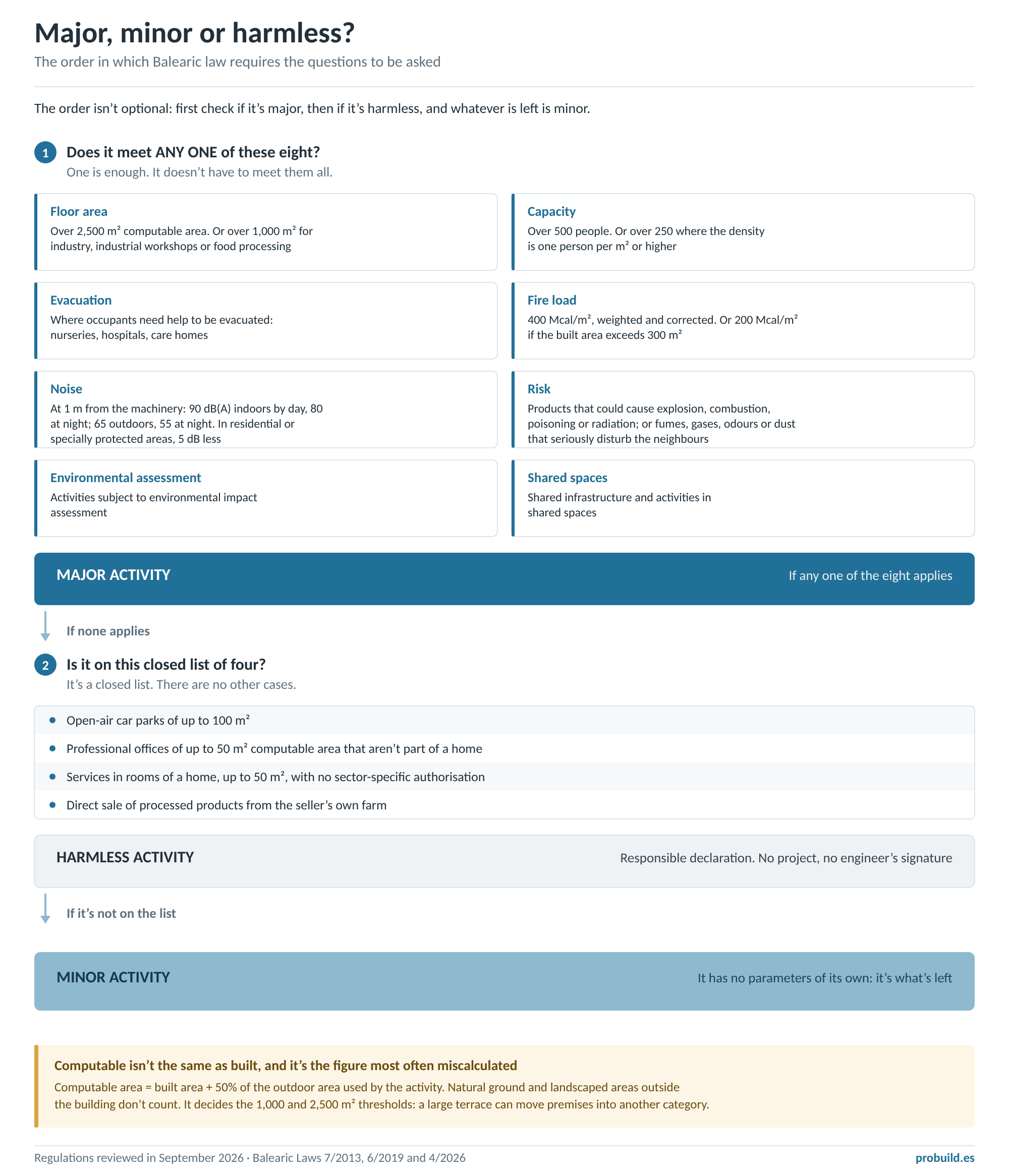
It’s a major activity if any one of these applies
| Floor area | More than 2,500 m² of computable area for any activity, except open-air car parks. Or more than 1,000 m² for industry, industrial workshops or food processing |
| Capacity | More than 500 people. Or more than 250 where the occupancy density is one person per m² or higher |
| Evacuation | Where occupants need help to be evacuated: nurseries, hospitals, care homes and similar |
| Fire load | 400 Mcal/m², weighted and corrected. Or 200 Mcal/m² if the built area exceeds 300 m² |
| Noise | At 1 m from the machinery: 90 dB(A) indoors by day, 80 at night; 65 dB(A) outdoors by day, 55 at night. In residential or specially protected areas, 5 dB less |
| Risk | Handling, dispatching or storing products that could cause explosion, combustion, poisoning or radiation; or producing fumes, gases, odours or dust that seriously disturb the neighbours |
| Environmental assessment | Activities subject to environmental impact assessment |
| Shared spaces | Shared infrastructure installations and activities in shared spaces |
And it’s harmless only in these four cases
It’s a closed list. There are no others:
- Open-air car parks of up to 100 m².
- Professional offices of up to 50 m² computable area that aren’t part of a home.
- Service activities in rooms of a home, up to 50 m² computable area, provided they don’t need any sector-specific authorisation.
- Direct sale of processed products from the seller’s own farm.
A harmless activity is dealt with by a responsible declaration (declaración responsable) from the owner of the business: no project and no engineer’s signature. If your premises fall into that group, we’ll tell you, and we won’t charge you for writing something that isn’t needed.
Watch the floor area: computable isn’t the same as built. The law defines computable area as the built area plus 50% of the outdoor area used by the activity. Natural ground and landscaped areas outside the building don’t count. It’s the figure that decides the 1,000 and 2,500 m² thresholds, and the one most often miscalculated: a large terrace can move premises into a different category.
The procedure: three pieces, in order
There’s a very widespread misunderstanding here, and it’s worth clearing up: the old “installation and works permit” no longer exists. The procedure was rewritten from scratch in 2019. A few stray references survive in articles that weren’t repealed, which is why you still hear about it, but there is no administrative decision to wait for — and so no deadline and no deemed approval either.
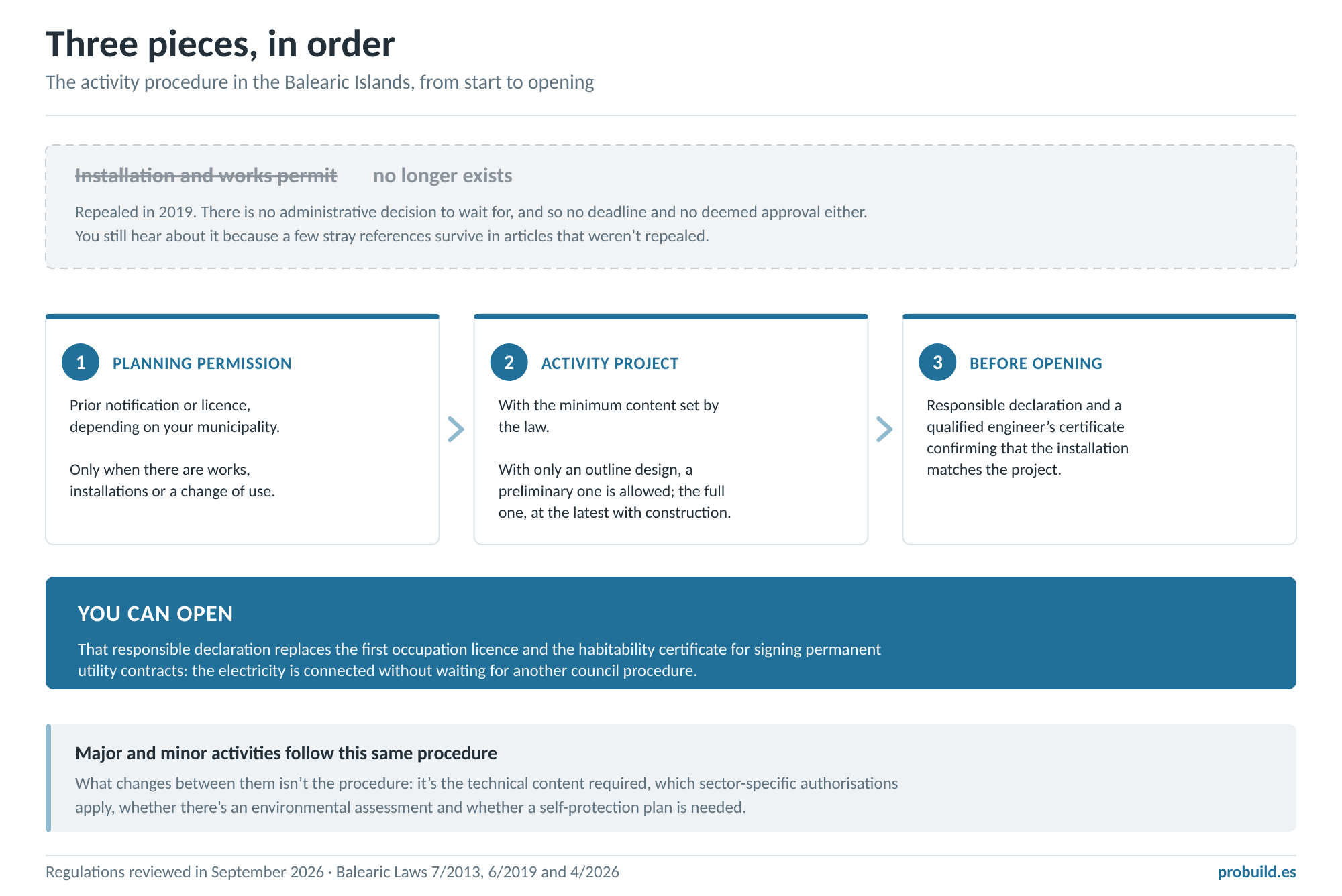
| Order | Piece |
|---|---|
| 1 | Planning permission. Prior notification or licence, depending on the municipality’s rules, when there are works, installations or a change of use |
| 2 | Activity project, with the minimum content the law sets. If there’s only an outline building design, a preliminary project is allowed, with the full one due at the latest with the construction project |
| 3 | Before opening: responsible declaration and a certificate from a qualified engineer confirming that the installations match the project |
Major and minor activities follow the same procedure. What changes between them isn’t the paperwork route: it’s the technical content required, which sector-specific authorisations apply, whether there’s an environmental assessment and whether a self-protection plan is needed.
And one that solves a classic problem: that responsible declaration replaces the first occupation licence and the habitability certificate for the purpose of signing permanent utility contracts. It’s what lets you get the electricity connected without waiting for another council procedure.
If your business is already open
Changes
A change has to be processed as a modification when it means a new activity or an extension of the existing one, or when it alters the fire safety conditions or creates new emissions or nuisance for the neighbours. Other work on the installations isn’t a modification under this law, and knowing that saves files nobody asked you for.
What saves the most money, and hardly anyone mentions: a modification must comply with current regulations, but it doesn’t require existing installations that aren’t part of the change to be brought up to date, unless a sector-specific rule expressly says so. And where adapting something is technically or financially unfeasible, alternative technical solutions of equivalent effectiveness must be accepted. If you’re being asked to upgrade the whole premises because you’re changing one part, this is what needs looking at.
The ten-year review
Every permanent activity must pass a technical review ten years after it starts, and every ten years after that. It’s carried out by an accredited inspection body or a qualified engineer, and records the current state with photographs, an assessment of whether the conditions have been maintained and, if there are any, the risk situations with their corrective measures. If the result is unfavourable, there are at least two months to put things right.
Many business owners don’t know about this obligation until the notice arrives.
If your premises in Palma opened before March 2014 and the activity is minor or harmless, the review is due by 31 December 2026. We carry it out for a fixed price: get in touch.
What we deliver
- Classification of the activity, with the computable area, capacity and fire load calculations behind it. It’s the first deliverable, and it’s in writing.
- Summary sheet and report: description, classification, location, area, capacity, electrical power and fire load.
- Planning justification: compatibility of the use with the municipality’s zoning plan.
- Fire safety: compartmentation, evacuation and fire protection equipment.
- Accessibility, acoustics, odours and waste.
- Installations fully defined: electrical, air conditioning and ventilation, plumbing, drainage, fire protection and fuels if any. The law requires it in those words, and that’s where the real work is.
- Calculation annexes, drawings, specification and budget.
- Close-out: qualified engineer’s certificate, test records and installers’ certificates.
Plus the corrections the authorities ask for, which with activity files are the rule rather than the exception. They’re included: we don’t charge for them separately.
Car parks
A small car park looks like a minor formality and hardly ever is. Three things trigger it:
- Mechanical ventilation: an electrical project is compulsory, whatever the power. A basement with mechanical extraction triggers it whether it has one space or thirty.
- Natural ventilation: an electrical project from more than five spaces.
- From 500 m² built area, fire hose reels and detection are required; and every automated car park needs automatic extinction, whatever its size.
Timing and fees
The timescale is agreed in writing when you commission us, after we’ve seen the premises. What affects it most isn’t the size: it’s whether there are works, whether the use is compatible with the zoning plan and whether the premises come with an unresolved history.
A fixed fee, agreed before we start, with the corrections included. Never a percentage of the cost of the works.
Frequently asked questions
How long does the council take to grant the licence?
There’s no activity licence to wait for. Since 2019 the system has been one of responsible declaration: you submit the technical documentation and, with the engineer’s certificate, you can open. What can take time is planning permission if there are works. The real timescale is set by preparing the project properly, not by the council counter.
I’m buying a business that’s already open. Do I need a new project?
If the activity stays the same and the premises aren’t altered, a change of ownership is usually enough. It becomes a modification when a new activity is introduced, the existing one is extended, the fire safety conditions change or new emissions appear. It’s worth checking before you sign the transfer: premises without their file in order are a problem you inherit.
My premises are in an old building and don’t comply with something. Can I still open?
Sometimes, through alternative technical solutions: where adapting is unfeasible, the law requires solutions of equivalent effectiveness to be accepted. The authorities have two months to respond, and no reply counts as approval, except in listed or protected buildings or where it contradicts the zoning plan. It’s an underused tool, and it solves a lot of premises in old town centres.
What if the premises don’t conform to the current zoning plan?
That’s the first thing we check, before drawing anything, because it can rule out the activity or limit which works are allowed. Planning compatibility is assessed against the municipality’s zoning plan, and in Mallorca every council has its own.
Who is responsible for what the project says?
The engineer who signs it. The law says so in so many words: once the technical documentation is submitted, the technician who signs it answers for the accuracy and truthfulness of the technical data it contains. In a system with no prior checks, that sentence is the whole guarantee. That’s why we never sign an activity project without visiting the premises.
What business are you opening?
With the type of business, the floor area and the municipality, we can point you to the right category in one call.
Regulations reviewed in September 2026: Balearic Law 7/2013 on the installation, access and exercise of activities, as worded after Law 6/2019 and Law 4/2026; Annex I as set by article 41 of Law 6/2019; Spanish Building Code CTE DB-SI (RD 164/2025); and REBT, ITC-BT-04.