
An installation can be perfectly built and still not exist as far as anyone is concerned. Legalising it means documenting it, certifying it and registering it — and that’s what you need to get the supply connected, to pass an inspection, and to have the paperwork ready when a buyer, a tenant or a surveyor turns up.
We don’t sell equipment, we don’t distribute any brand and we don’t install what we legalise. Our only income is the fee you pay us. If what’s been installed can’t be legalised as it stands, we tell you before we charge you, not halfway through the job.
When you need it
- A new installation that was never registered. It was installed and nobody ever applied for commissioning.
- Alterations to an existing installation. Increasing the power, changing the type of energy or adding renewables triggers the requirement on its own.
- Changes in premises with a business activity. Since June 2026, changes to installations require a certificate from a qualified engineer confirming that what was built matches the amended project.
- Selling or letting a property. The paperwork comes up when the buyer does, and it usually comes up late.
- Changing electricity supplier or increasing contracted power, when you’re asked for the installer’s certificate and registration that nobody has.
Technical report or project: where the line is
For thermal installations, it comes down to capacity: between 5 and 70 kW of heating or cooling generation, a technical report is enough, and a licensed installer can sign it; above 70 kW you need a project by a qualified engineer. All the heating generators are added together on one side and all the cooling ones on the other, and the larger of the two counts.
For low voltage there’s no single threshold: it depends on the type of installation. A detached house needs a project above 50 kW, but a pool needs one from 5 kW, and a car park with mechanical ventilation needs one whatever the power. They’re all set out on the building services engineering page.
The one most often legalised wrongly is replacing an oil boiler with a heat pump. It’s treated as swapping a unit, and it isn’t: changing the type of energy is an alteration that needs a document beforehand. It comes to light when applying for commissioning, with the machine already in place.
Where it’s registered, and why it matters
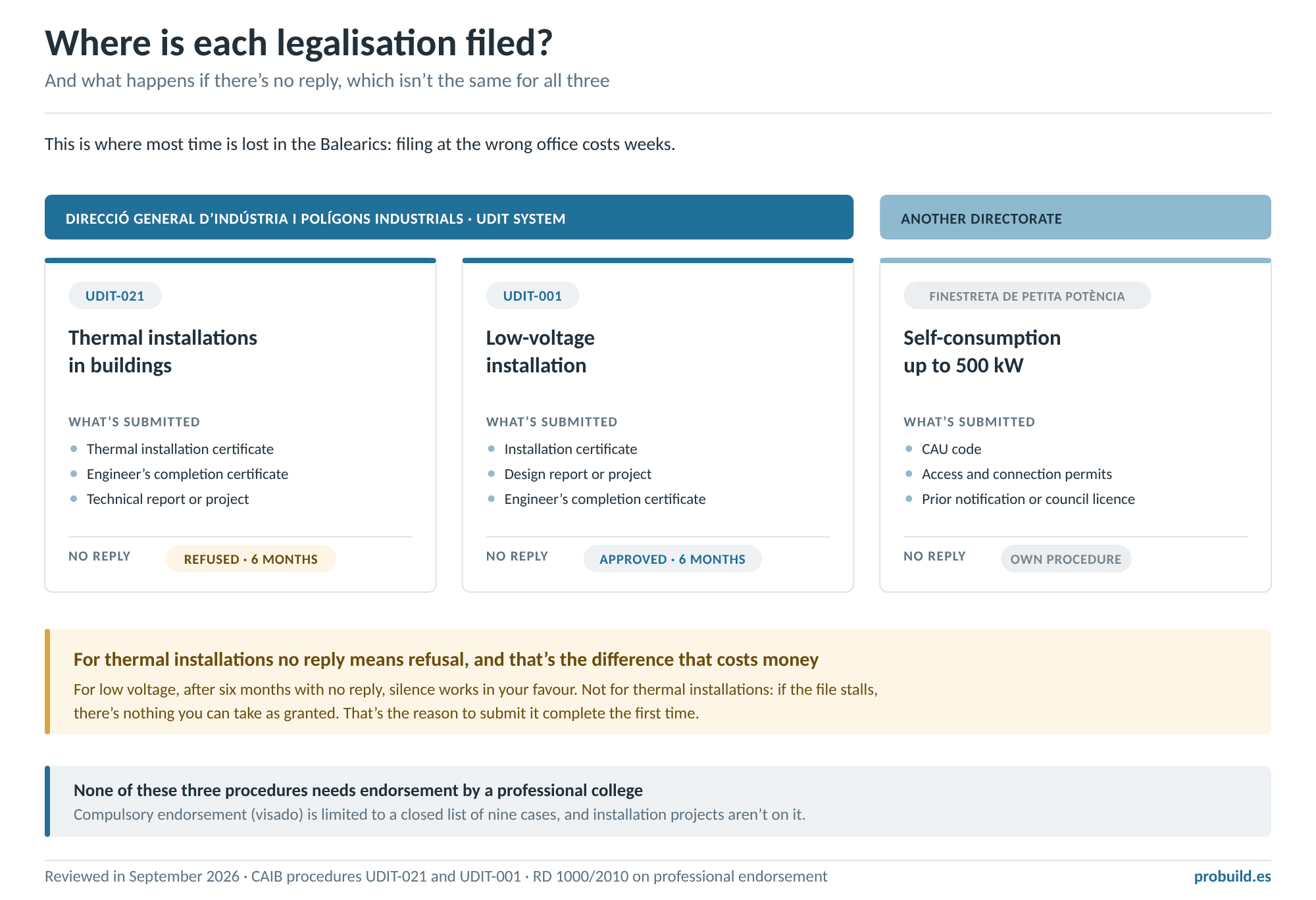
This is where most time is lost in the Balearic Islands. Thermal and low-voltage installations are registered with the Direcció General d’Indústria i Polígons Industrials, through the UDIT system. Self-consumption solar PV goes through a different directorate, with its own procedure. Filing at the wrong office costs weeks.
| Procedure | Code | What’s submitted | If there’s no reply |
|---|---|---|---|
| Thermal installations in buildings | UDIT-021 | Thermal installation certificate, engineer’s completion certificate and report or project | Refused after 6 months |
| Low-voltage installation | UDIT-001 | Installation certificate, design report or project, and engineer’s completion certificate | Approved after 6 months |
| Self-consumption up to 500 kW | Finestreta de petita potència | CAU code, access and connection permits, prior notification or municipal licence | — |
Watch out with thermal installations: silence means refusal. For low voltage, after six months with no reply, silence works in your favour. Not for thermal installations: if the file stalls, there’s nothing you can take as granted. That’s the reason to submit it complete the first time.
And one that saves money: none of these procedures needs endorsement by a professional college (visado). Compulsory endorsement is limited to a closed list of nine cases, and installation projects aren’t on it.
Installation upgrades without building works: what changed in 2026
Since 14 June 2026, installations that don’t involve building works can go ahead once the technical documentation has been submitted, without waiting for prior permission. It directly affects air-conditioning, solar PV and low-voltage upgrades in commercial premises and tourist accommodation: what used to mean waiting is now a matter of filing.
It’s a genuine simplification, but it shifts the weight onto the documentation: what’s submitted has to be right, because there’s no longer a prior check to stop it.
What we deliver
- A site visit and survey of what’s installed, which is what decides whether it can be legalised as it is or something has to be corrected first.
- Technical report or project, depending on which side of the threshold it falls.
- Diagrams and drawings of what was actually built, not of what was planned.
- Certificates: the engineer’s completion certificate and, where it applies, the certificate for changes to the installation.
- The full procedure with the authorities, corrections included.
Timing and fees
A simple technical report is one of the quickest jobs we do; a full survey of an old installation with no paperwork isn’t. The timescale is agreed in writing when you commission us, after the site visit, which is the only way to know what we’re dealing with.
A fixed fee per deliverable, agreed before we start, with corrections included.
Frequently asked questions
The installation is years old and was never registered. Can it be legalised now?
Almost always, but it has to be seen first. What gets certified is what exists, and sometimes what was built doesn’t meet today’s requirements. In that case there are two routes — correct it and legalise it, or legalise the part that does comply — and it’s worth knowing which before commissioning the work, not halfway through.
My installer says he’ll handle all the paperwork. Do I need an engineer?
Below the thresholds, no: the technical report for a 5 to 70 kW thermal installation or a low-voltage installation can be signed by the licensed installer, and he’s right to do it. Above the threshold, you do need a qualified engineer. The useful question isn’t who files it, but which side of the threshold your installation is on.
How long do the authorities take?
The deadline to decide on commissioning applications is six months. For low voltage, no reply means approval; for thermal installations it means refusal, so an incomplete file won’t sort itself out. In practice, what sets the real timescale is how many times you’re asked for corrections.
Does it need endorsement from the professional college?
Not for these procedures. Compulsory endorsement is limited to a closed list of nine cases, and thermal, electrical and solar PV projects aren’t on it. They’re only endorsed when they form part of the building’s construction project or its final completion certificate.
I’ve lost all the paperwork for the installation. Is that a problem?
No. A large part of the job is precisely surveying what’s there: measuring, identifying equipment, checking cable sizes and protections and rebuilding the diagrams. It’s not the same as starting from an existing project, but it can be done, and it’s a common job.
Got an installation that isn’t legalised?
Knowing what installation it is, its power and whether the premises have a business activity is enough to tell you which route it takes.
Regulations reviewed in September 2026: RITE (Royal Decree 1027/2007, amended by RD 178/2021); REBT (RD 842/2002, ITC-BT-04 as worded by RD 1053/2014); Balearic Law 7/2013 as worded after Law 4/2026; RD 1000/2010 on professional endorsement; and the CAIB’s UDIT-021 and UDIT-001 procedures.