
Many owners building or renovating in Mallorca don’t live here. They can’t turn up on site on a Tuesday morning, they don’t follow the day-to-day of a build run in Spanish, and they find out what’s happening from photos sent by someone with an interest in everything looking fine.
We offer two different services for that, with different scopes. One follows the whole build on your behalf: how it’s progressing, what’s being spent, what’s being decided and what’s going off track. The other supervises a specific installation, the one we’ve designed. Neither replaces the contractor’s site manager or the architect: both exist because there’s a gap between what’s agreed and what actually happens on site, and someone has to measure it while it can still be put right.
We don’t run the works, we don’t manage the trades and we don’t hire anyone on your behalf. Nor do we charge a percentage of the certified work: whoever earns a percentage of what’s certified has no incentive to question a valuation. Our only income is our fee.
Who does what on a Spanish building site
It’s the question behind all of this, and hardly anyone answers it clearly: if I already have a contractor with a site manager and an architect in charge, why would I need anyone else?
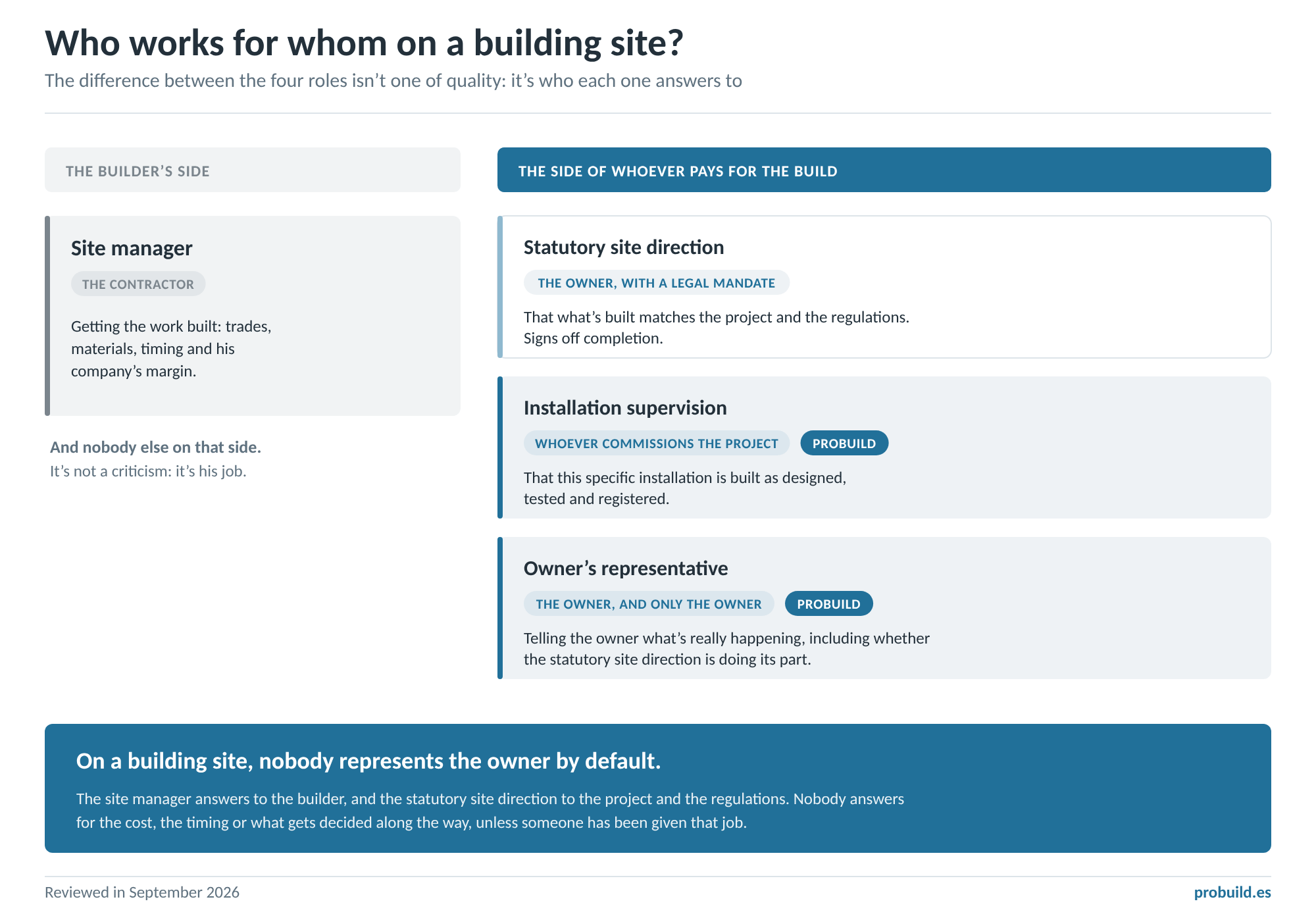
| Role | Works for | Answers for |
|---|---|---|
| Site manager (jefe de obra) | The contractor | Getting the work built: trades, materials, timing and his company’s margin |
| Statutory site direction (dirección facultativa) | The owner, with a legal mandate | That what’s built matches the project and the regulations. Signs off completion |
| Installation supervision | Whoever commissions the project | That that specific installation is built as designed, tested and registered |
| Owner’s representative | The owner, and only the owner | Telling the owner what’s really happening, including whether the statutory site direction is doing its part |
The last two are ours. And the difference from the site manager isn’t one of quality: it’s who each of them answers to. He works for the builder, and that’s not a criticism: it’s his job. The point is that on a building site nobody represents the owner by default. The site manager answers to the builder, and the statutory site direction to the project and the regulations. Nobody answers for the cost, the timing or what gets decided along the way, unless someone has been given that job.
Owner’s representation when you’re not here
It’s the opposite of photos chosen by someone else: someone with technical judgement who goes to site on your behalf and tells you, in English, what they see.
The monthly report
Always with the same structure, so you can compare this month’s with last month’s:
- Actual progress against the programme. Not “it’s going well”: which items are done and which aren’t.
- Dated photos of what matters, not the pretty ones.
- Deviations in time and cost, with what caused them.
- Warnings: what will be a problem next month if nobody does anything.
- Pending decisions that need your answer, each with its deadline.
What it isn’t
It’s worth being precise, because there’s a lot of hot air sold in this area:
- It doesn’t run the works or manage the trades. That’s the contractor’s site manager’s job, and he does it better than any outsider.
- It doesn’t replace the statutory site direction. It follows it and checks that it does its job.
- It isn’t another layer of management. If your build is already going well and you have someone to talk to, you don’t need this, and we’ll tell you so.
Supervision of the installation
An installation project is only worth as much as its execution. Supervision is what closes that gap: checking what’s being installed against the project, while it can still be corrected and not once it’s been covered up.
What we check, and when
| Stage | What’s checked |
|---|---|
| Before starting | That the equipment bought is what was designed, or a genuine equivalent, and not whatever the installer had in stock |
| Before covering up | Routes, cable sizes, insulation and service penetrations. It’s the visit that saves the most money, and the one most often skipped |
| Once installed | Pressure and leak tests, balancing, electrical measurements and checks on protections |
| At handover | Acceptance, final documentation and the supervision certificate, which is what allows the installation to be registered |
Every visit ends with written minutes: what was checked, what’s missing and what needs deciding, in writing and dated. It isn’t bureaucracy — it’s what lets you raise something three months later without it being your word against theirs.
It sits on top of the installation project and is done by the same person who signed it. If the project was written by someone else, it can still be supervised: it has to be reviewed first, and we say so from the start.
When it’s worth it, and when it isn’t
It’s worth it if…
- You can’t be on site regularly, because of distance or your diary.
- The build is long, with many technical decisions along the way.
- There are major installations and you want someone to look at them before they’re covered up.
- You’ve already had a build go wrong and don’t want a repeat.
It isn’t if…
- You live next door and drop by the site several times a week.
- It’s a short refurbishment with no significant installations.
- You already have an architect you talk to and trust.
- What you’re looking for is someone to manage the build for you. That’s a different job.
Timing and fees
Owner’s representation is a fixed monthly fee, with at least one site visit a month and the report included. No minimum term: if a month doesn’t add value, it stops.
Installation supervision is commissioned with the project and lasts as long as the works. A fixed fee, agreed before we start, with the number of visits agreed in writing.
Never a percentage of the certified work, for the reason given in the box above.
Frequently asked questions
I already have an architect and a builder. Isn’t this putting a third party in the middle?
It’s the right question, and sometimes the answer is yes. If the build is going well and you have someone to talk to, you don’t need anyone else. What this adds is someone who answers neither to the builder nor to the designer, and who can therefore tell you something isn’t right without it costing them the job. If you don’t need that, all the better.
Won’t it create friction with the builder?
Not if the job is done properly. We don’t give orders to the trades, we don’t argue with the site manager in front of his team and we don’t get involved in his organisation. We check, document and report to the owner. A builder who does good work usually welcomes having things in writing.
Can you come in once the build has started?
Yes, and that’s the most common case: almost nobody calls before there’s a problem. The first step is a visit to see where things stand and what can still be checked. If the installation has already been covered up, some things can’t be verified without opening up, and we say so at the start instead of finding out halfway.
My build isn’t in Mallorca. Can you still help?
No. This depends on going to site, and we work in Mallorca. A monthly report done by video call isn’t a report: it’s a transcript of what someone else tells you.
What happens if you find something serious?
It’s documented with dated photos, you’re told immediately — without waiting for the monthly report — and you’re given the options and the time you have for each. The decision is always yours: we don’t order a build to stop and we don’t sign anything in your name.
Is your build in Mallorca and you’re not?
Tell us what stage it’s at and who’s involved right now. If what you already have is enough, we’ll tell you.
Installation supervision and the statutory site direction of the building (dirección facultativa) are different roles. This page describes the former, and the follow-up on the owner’s behalf, which has no statutory role: it’s a private agreement between the owner and us.