
If you are building or renovating a house in Mallorca from abroad, the installations — heating, cooling, hot water, the pool, the electrics — are the part you see least and pay for longest. Above certain thresholds, Spanish law no longer accepts a report signed by the installer and requires a project by a qualified engineer. That is the job: deciding which document is needed, writing it, supervising the installation as it goes in and getting it registered.
We don’t sell equipment, we don’t distribute any brand and we don’t install what we design. Our only income is the fee you pay us. If the project says a machine is unnecessary, it’s because it is.
When you’re not on the island
Most problems with installations are decided on site, on a day the owner isn’t there: a heat pump swapped for a cheaper model, a cable run that doesn’t match the drawings, a test that was never done. The project gives the installer something specific to build, and gives you something specific to check it against.
- Site visits with written minutes at the stages that matter: before walls are closed, at testing and at handover.
- What was installed, checked against what was designed, with photos, so changes are agreed before they happen, not discovered afterwards.
- One person who signs and answers for it: the engineer who designed the installation is the one who supervises it and certifies it.
If you need someone to follow the whole build on your behalf — progress, cost and decisions, not just the installations — that’s a different service: site supervision and owner’s representation.
When you need a project and when a technical report is enough
It’s the first question in any job, and the one that decides the cost. These are the thresholds.
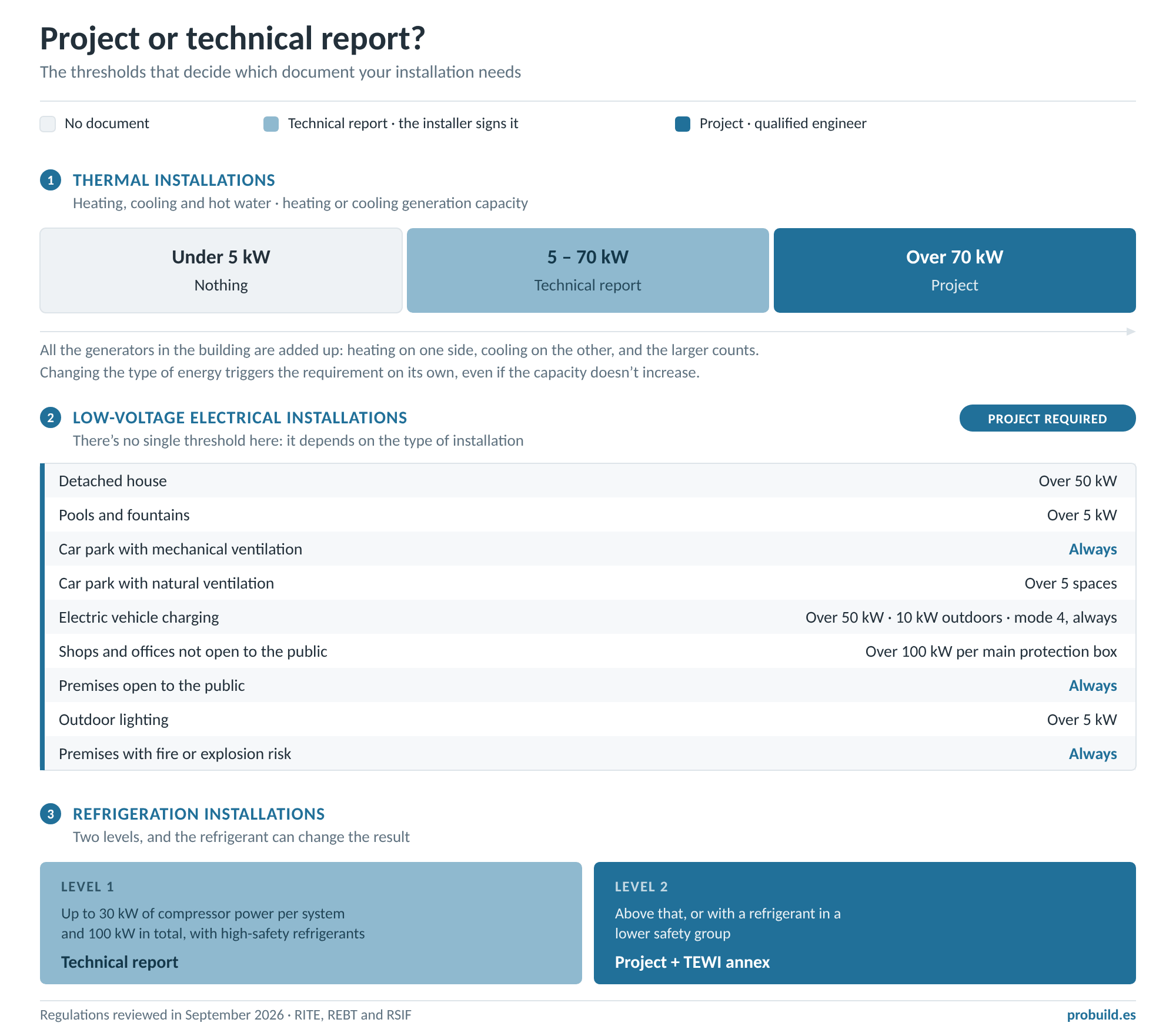
Thermal installations: heating, cooling and hot water
| Heating or cooling generation capacity | Document required |
|---|---|
| Over 70 kW | Project by a qualified engineer |
| Between 5 and 70 kW | Technical report (memoria técnica). A licensed installer can sign it |
| Under 5 kW | Nothing |
Three counting rules that change the result, and that almost nobody checks:
- All the generators in the building are added together, heating on one side and cooling on the other, and the larger of the two counts. Solar thermal doesn’t count.
- Changing the type of energy triggers the requirement on its own. Replacing an oil boiler with a heat pump isn’t swapping a unit: it’s an alteration that needs a document beforehand.
- In a house with a heated pool, the cooling total rarely reaches 70 kW, but the heating total often does. That’s the threshold that turns a small job into a project.
Low-voltage electrical installations
There’s no single threshold here: there’s a table by type of installation. The ones that come up most in Mallorca:
| Installation | Project required |
|---|---|
| Detached house | Over 50 kW |
| Pools and fountains | Over 5 kW |
| Car park with mechanical ventilation | Always, whatever the power |
| Car park with natural ventilation | Over 5 spaces |
| Electric vehicle charging | Over 50 kW · over 10 kW if outdoors · always with mode 4 charging |
| Shops and offices not open to the public | Over 100 kW per main protection box |
| Premises open to the public | Always |
| Outdoor lighting | Over 5 kW |
| Premises with a risk of fire or explosion | Always |
The two that surprise people most. The pool: filtration pump, heat pump, lighting and spa jets pass 5 kW as soon as the pool is more than a basic tank, and that’s how a house ends up needing an electrical project even below 50 kW. And the basement garage with mechanical extraction, which needs a project however many spaces it has.
Refrigeration installations
These are split into two levels. Level 1 — up to 30 kW of compressor power per system and 100 kW in total, with high-safety refrigerants — needs only a technical report. Above that, or with refrigerants in a lower safety group, it’s Level 2 and needs a project, with its TEWI annex.
What we deliver
- Project report, with the regulatory justification chapter by chapter and its revision date.
- Calculation annexes: thermal loads, capacities, flow rates, cable sizes and protections.
- Drawings: layouts, schematic diagrams and single-line diagrams.
- Specification and bill of quantities, so you can ask for three quotes that can actually be compared, instead of three that look nothing alike.
- Supervision of the installation: site visits with minutes, checking what’s built against what’s designed, testing, balancing and handover.
- Commissioning: full registration with the authorities and the engineer’s completion certificate.
Where it’s registered in the Balearic Islands
A detail that costs weeks: thermal and low-voltage installations are registered with the Direcció General d’Indústria i Polígons Industrials, through the UDIT system, not with the energy department. Self-consumption solar PV goes through a different route altogether.
| Procedure | Code | If there’s no reply |
|---|---|---|
| Thermal installations in buildings | UDIT-021 | Refused after 6 months |
| Low-voltage installation | UDIT-001 | Approved after 6 months |
Neither needs endorsement by a professional college (visado). Compulsory endorsement is limited to a closed list of nine cases, and installation projects aren’t on it: they’re only endorsed when they form part of the building’s construction project or its final completion certificate. If someone charges you for it separately, ask why.
Timing and fees
The timescale is agreed in writing when you commission us. It depends mostly on one thing: whether the architect’s design is settled or still changing. With a final layout and known loads, the work can be pinned down; with an outline design still evolving, what we deliver first is a preliminary version, finalised later.
A fixed fee, agreed before we start. Never a percentage of the construction cost: whoever charges a percentage earns more the more expensive the installation turns out, and that’s exactly the incentive you don’t want in the person designing it.
Frequently asked questions
Can my installer sign the report and save me the project?
Yes, below the thresholds. For thermal installations between 5 and 70 kW the technical report can be signed by the licensed installer, and the same goes for the low-voltage design report. Above the threshold you need a qualified engineer. What matters is checking the threshold before you commission the work, not after.
I’m replacing an oil boiler with a heat pump. Do I need anything?
Yes. Changing the type of energy is an alteration to the thermal installation and needs a project or a technical report beforehand, depending on the resulting capacity. It’s the most common mistake: it’s treated as replacing a unit, and it’s discovered when applying for commissioning, with the machine already in place.
Do you also supervise the installation work?
Yes, and that’s where the project actually pays for itself. Site visits with minutes, checking what’s built against what’s designed, testing, balancing and handover. What we don’t do is install: we never build the installation we’ve designed.
Will you work with the installer I already have?
Yes. We have no installers of our own and no agreements with any. If you already have one you trust, all the better: the project gives them something specific to build, and you something specific to check against.
Can you take on something that has already started?
It depends on the stage. Before installation starts, almost always. Once the installation is in place, what’s needed is to survey what’s there and legalise it, which is a different job: see legalisation of installations.
Project or technical report?
With the expected loads and the use of the building, we can tell you in one call. That call is free.
Regulations reviewed in September 2026: RITE (Royal Decree 1027/2007, amended by RD 178/2021); REBT (RD 842/2002, ITC-BT-04 as worded by RD 1053/2014); RSIF (RD 552/2019); RD 1000/2010 on professional endorsement; and the CAIB’s UDIT-021 and UDIT-001 procedures.