
A self-protection plan (plan de autoprotección) isn’t a folder to show at an inspection. It’s the document that sets out what can happen in your establishment, what resources are there to respond and who does what when it happens. It’s compulsory for certain activities, and it has to be reviewed periodically.
We don’t sell equipment, we don’t distribute any brand and we don’t install what we design. Nor do we sell extinguishers, signage or maintenance contracts. Our only income is the fee you pay us, so whatever the plan says is needed is what’s actually needed.
Who has to have one
Since 11 October 2026 the list is set by the Basic Self-Protection Planning Directive. These are the thresholds in its catalogue that come up most in Mallorca. Exceeding the one for your type of activity is enough:
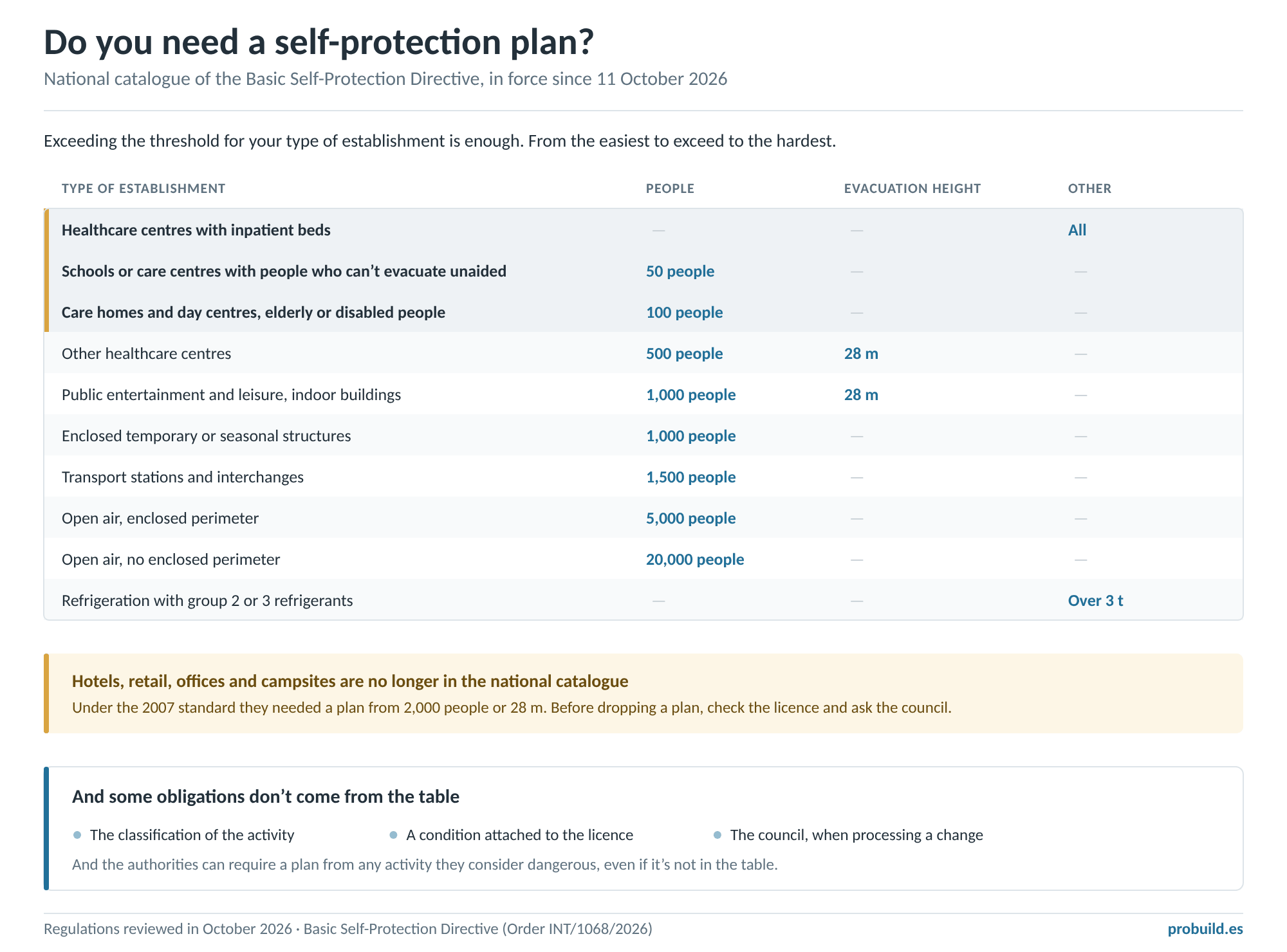
| Type of activity | From |
|---|---|
| Healthcare centres with inpatient beds | All, whatever the number of beds |
| Other healthcare centres | 500 people, or an evacuation height of 28 m |
| Schools or care centres with people who can’t evacuate unaided | 50 people |
| Care homes and day centres for the elderly or people with disabilities | 100 people authorised in the licence, not counting staff |
| Public entertainment and leisure, in indoor buildings | 1,000 people, or an evacuation height of 28 m |
| Enclosed temporary or seasonal structures | 1,000 people |
| Open-air activities | 5,000 people with an enclosed perimeter; 20,000 without |
| Road transport stations and interchanges | 1,500 people |
| Refrigeration installations with second or third safety group refrigerants | Over 3 t of refrigerant |
| Industrial establishments | Fire load of 13,600 MJ/m² or more (high intrinsic risk, level 8) |
Hotels, retail, offices and campsites are no longer in the national catalogue. Under the 2007 standard they needed a plan from 2,000 people or an evacuation height of 28 m, and the new Directive no longer includes them. That doesn’t mean a hotel can simply drop its plan: the activity licence may require it as a condition, the council may ask for it, and the authorities can require a plan from any activity they consider dangerous even if it’s not in the catalogue. And the Balearic government hasn’t yet said how it will apply the change. Check before cancelling a plan.
And beyond the catalogue, the obligation can come by other routes: the classification of the activity, a condition attached to the licence, or the council itself when processing a change. The Directive also allows a joint plan to be required from activities sharing a building. If you’ve been asked for one and don’t know why, that’s the first question we answer.
The change that affects building services most is refrigeration: a plant with more than 3 t of second or third safety group refrigerant needs a self-protection plan on its own, whatever the capacity of the building.
The rules changed on 11 October 2026
Almost every self-protection plan in the Balearic Islands today was written under the 2007 Basic Self-Protection Standard, Royal Decree 393/2007. Royal Decree 524/2023 repealed it, but it remained the reference until a new standard arrived.
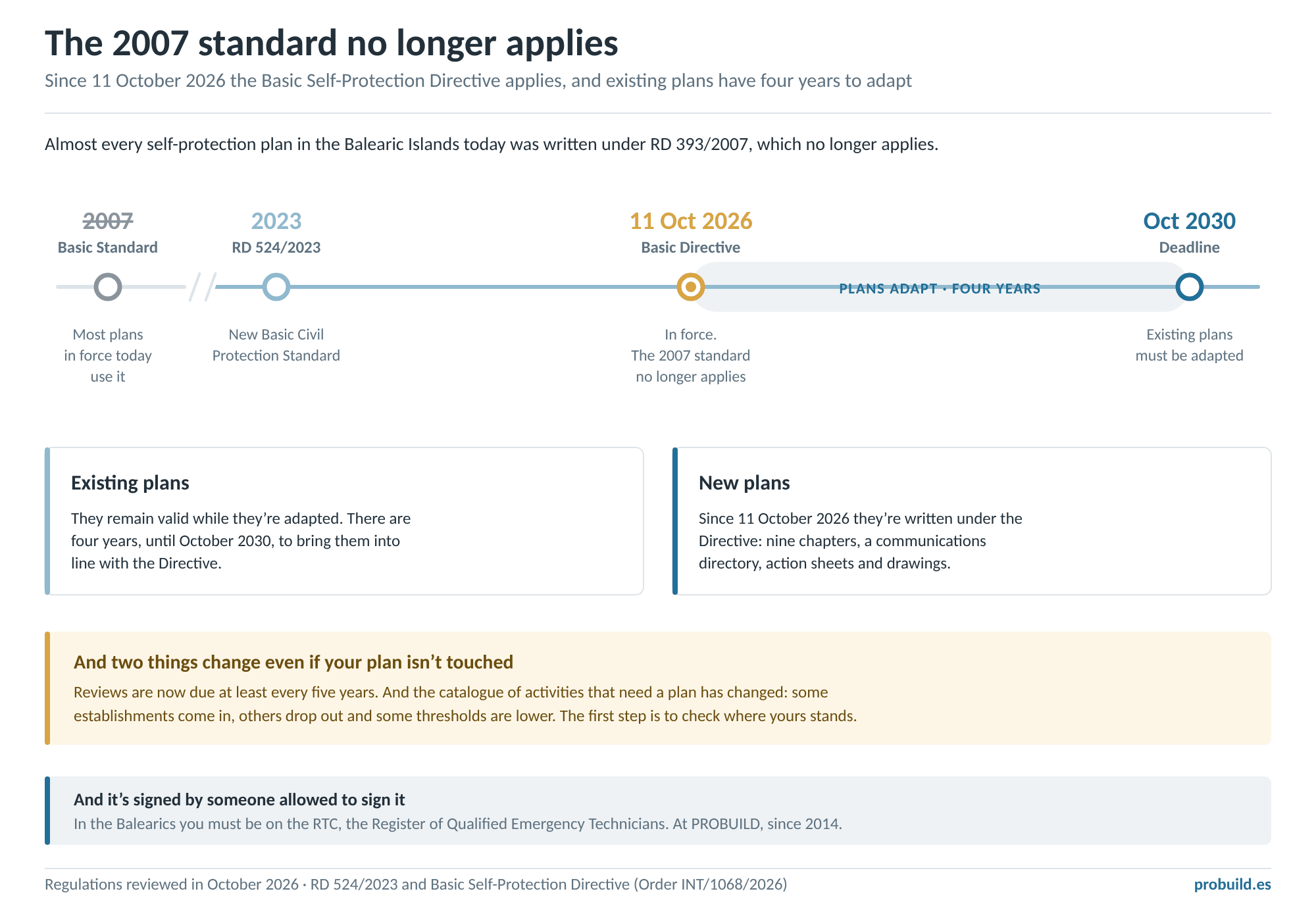
That new standard is here. On 6 October 2026 the Council of Ministers approved the Basic Civil Protection Planning Directive on self-protection, published by Order INT/1068/2026 in the Official State Gazette (BOE) of 10 October and in force from the following day. The 2007 standard no longer applies.
What it means if you already have a plan: existing plans have a maximum of four years to adapt to the Directive, that is, until October 2030. There’s no need to throw them away, but they do need to be rewritten with the new content before then. The sensible thing is to do it at the next review rather than paying twice.
What changes in the document: the plan now has nine chapters, from identifying the owner to the programme for maintaining its effectiveness, plus three annexes: a communications directory, action sheets for each type of emergency, and drawings.
Who can sign it
This is where it differs from other engineering work, and it explains why not every practice offers it. In the Balearic Islands there are two separate registers, and they’re constantly confused:
| Register | What’s registered | Whose procedure it is |
|---|---|---|
| RGPA — General Register of Self-Protection Plans | The plan | The establishment’s owner. We handle it for you |
| RTC — Register of Qualified Emergency Technicians | The technician who signs it | The technician. It’s a prior qualification |
To write and sign a self-protection plan in the Balearic Islands, you have to be registered with the RTC. It’s neither automatic nor immediate: there are qualification requirements and a decision period of up to six months.
At PROBUILD, the engineer who signs has been registered with the RTC since 2014.
What we deliver
- A site visit and analysis of the establishment. Risk is assessed on site, not on the drawings: where everything is, how people get out and what goes wrong when the building is full.
- Identification and assessment of risks, internal and from the surroundings.
- Inventory of protection and self-protection resources, with their actual condition and the gaps found.
- Emergency action plan: classification of emergencies, procedures, and who does what in each one, with its action sheets.
- Emergency organisation: teams, roles and cover, sized for the staff you actually have, including nights and the low season.
- Drawings of location, evacuation, fire compartments and protection equipment.
- Implementation: staff training, signage and a drill, with records.
- Registration with the regional register, followed through until it’s resolved.
A plan that isn’t implemented is useless: it’s the part most often skipped, and the first thing noticed at an inspection, because the staff are asked and the staff don’t know.
Not a one-off document
Under the 2026 Directive the plan must be reviewed at least every five years — under the 2007 standard it was three — unless sector-specific rules set a shorter period. And also whenever something relevant changes in the establishment: a refurbishment, a change in capacity, a new activity or a change in the organisation. Drills, at least once a year.
We handle that part with an advance reminder: we tell you when it’s due before it expires, not after.
Timing and fees
The timescale depends on the size of the establishment and how much documentation already exists. It’s agreed in writing when you commission us, together with the fee, after the site visit: before anyone has seen the place, any timescale they give you is a made-up number.
A fixed fee, agreed before we start, with implementation and registration included. Never a percentage of anything.
Frequently asked questions
I have a plan from several years ago. Is it still valid?
Yes, for now. Existing plans have until October 2030 to adapt to the 2026 Directive. The sensible thing is to adapt it at the next review, or sooner if your activity has changed. And if your establishment is a hotel, a shop or an office, the first question is a different one: whether you’re still required to have one.
My hotel is no longer in the catalogue. Can I stop having a plan?
Don’t assume so. The national catalogue no longer including hotels doesn’t cancel what your activity licence says, what the council asks for or what the regional government may require, and it hasn’t said yet. And a well-made plan is still what organises an evacuation with the hotel full. What does change is the room to decide: we’ll tell you in writing what you’re required to do and what you’re not.
Can my fire extinguisher company do it?
The plan has to be signed by a technician registered with the regional register of qualified technicians. And there’s a second issue, one of judgement: whoever sells the protection equipment has an interest in how much equipment the plan recommends. We don’t sell or maintain equipment, so that conflict doesn’t exist.
Is it the same as the occupational health and safety emergency plan?
No, although they overlap and shouldn’t contradict each other. The health and safety plan looks after the workers and comes under employment law. The self-protection plan looks after the whole establishment — staff, users and visitors — and is registered with civil protection. If you already have the health and safety one, it’s put to use.
Do we have to run a drill?
Yes, at least once a year. A plan that isn’t implemented is just paper: staff training and the drill are part of the job, not an extra. And it’s the first thing checked at an inspection, because all it takes is asking whoever is on reception.
My establishment is below the threshold. Can I have one anyway?
Yes, and sometimes it pays. Some insurers take it into account, some corporate clients ask for it, and some councils impose it as a condition even when the catalogue doesn’t require it. The Directive itself expects activities outside the catalogue to use its plan format for their own procedures. If you’re just below the threshold, we’ll tell you whether it makes sense in your case.
Been asked for a self-protection plan?
Tell us what the establishment is, its capacity and who asked you for it. That’s enough to know whether you’re obliged and by which route.
Regulations reviewed in October 2026: Royal Decree 524/2023 of 20 June, Basic Civil Protection Standard; Basic Civil Protection Planning Directive on self-protection, approved by the Council of Ministers on 6 October 2026 and published by Order INT/1068/2026 (BOE of 10 October); and Balearic Decree 8/2004, implementing the Emergency Management Law.