
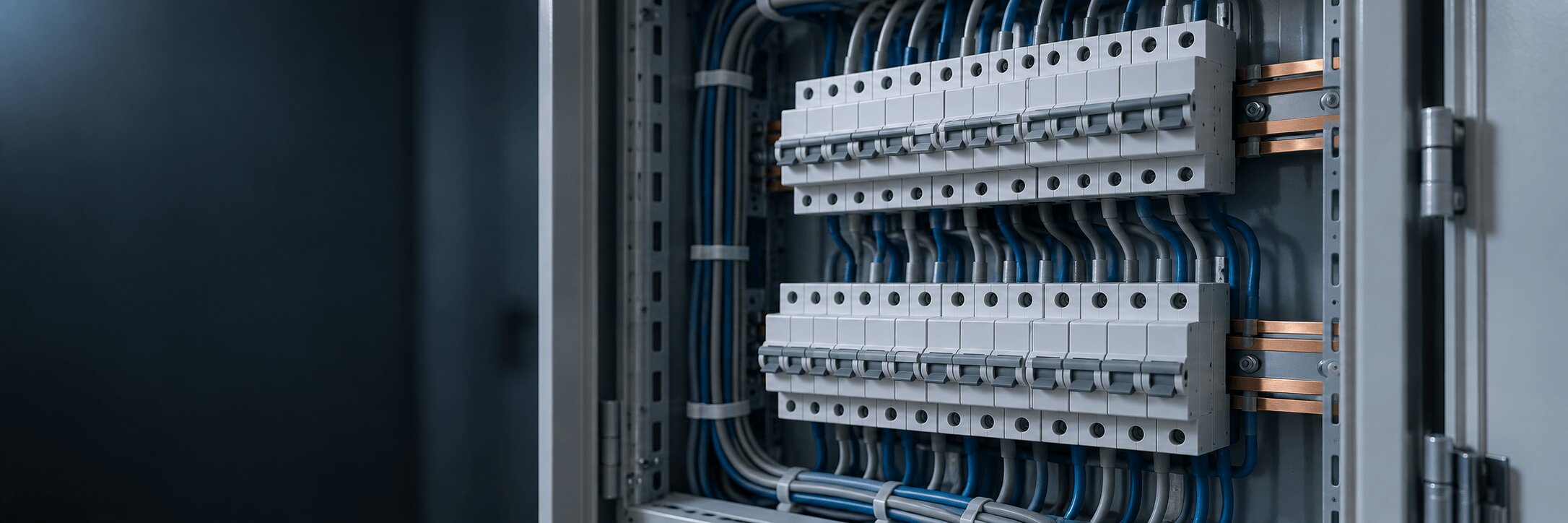
Commissioning can fail for reasons that don’t appear on any drawing. This one failed for two: a closed valve that stopped the system being evacuated, and a mains voltage of 430 V on a machine rated for 380 to 415 V. The second one teaches something worth knowing before you order a heat pump for a country house: the tolerance the law allows the grid is wider than the one the machine accepts.
The case
A house on rural land in Mallorca, with an air-to-water heat pump system and VRF. The works were finished and the owners were arriving for the holidays, expecting heating and hot water.
The first obstacle was paperwork. The manufacturer’s service team, who had to commission the machine, listed a permanent electricity supply among their requirements. The house was still on its temporary builder’s supply: without the end-of-works certificate there is no first occupation licence, without that the utility won’t connect the permanent supply, and in some municipalities that certificate takes more than a year. In the end the manufacturer agreed to commission on the temporary meter, because the supply was the same one the house would have afterwards.
And then both things went wrong.
First failure: evacuating with the valves closed
Before charging refrigerant, the whole refrigeration circuit has to be evacuated. In a VRF system, the electronic expansion valves in the indoor units can stay closed when they have no power, and part of the circuit is cut off from the vacuum pump. Many manufacturers solve this with a service mode that opens the valves, but that mode needs the machine powered up.
Here they couldn’t be opened and part of the installation wasn’t fully evacuated. It’s an installation fault, the installer’s to fix, and it has a solution, but it means doing it again.
Second failure: 430 V on a 380–415 V machine
Measured at the supply intake, the three-phase grid gave 430 V between phases. The machine’s rating plate asked for between 380 and 415 V. Outside that range, the machine will usually not start, or will trip on its own protection.
The interesting part is what you compare it against. The nominal voltage of low-voltage networks in Spain is 230 V between phase and neutral and 400 V between phases (Low Voltage Electrotechnical Regulations, Article 4). And the variation the distribution company is allowed is set in Royal Decree 1955/2000, Article 104.3: the maximum variation of the supply voltage is ± 7% of the declared voltage.
| Minimum | Maximum | |
|---|---|---|
| What the law allows the grid (400 V ± 7%) | 372 V | 428 V |
| What this machine accepted | 380 V | 415 V |
| What was arriving | 430 V | |
At 430 V the grid was 2 V above the legal limit, and that is a fault the distribution company has to correct. We opened an incident with the measurements and the distributor brought the voltage down. With the grid back in range and the evacuation redone, commissioning succeeded at the third attempt.
But look at the table: between 415 and 428 V the grid complies with the law and the machine doesn’t work. Had the voltage been 420 V, there would have been nothing to claim. The range the equipment accepts is narrower than the one the grid can legally deliver, and that gap belongs to nobody: it has to be planned for.
What we now do before commissioning
- Compare the rating plate with the grid when choosing the machine, not when starting it. If the equipment has a narrow voltage range, the design says so and either another machine is chosen or measures are planned.
- Measure the voltage between phases before commissioning day, and more than once: on lightly loaded rural networks, or with a lot of solar PV exporting at midday, the voltage rises at certain times.
- If it goes above 428 V or below 372 V, open an incident with the distribution company, with the measurements. It’s outside the regulatory limit and it’s theirs to fix.
- Go through the commissioning requirements with the manufacturer —permanent supply, evacuation mode, access— weeks ahead, not the day before.
None of this is exotic. It’s the kind of thing a properly done building services design settles before the machine reaches site, and that without one is discovered with the owners at the door.
What we do. We design and supervise heating, cooling and hot water installations, commissioning included, without selling or fitting the equipment. Building services engineering · Tell us about your project.
Regulations reviewed in October 2026: Royal Decree 842/2002, Low Voltage Electrotechnical Regulations, Article 4 (nominal voltages); and Royal Decree 1955/2000, Article 104.3 (limits on supply voltage variation). A real case from a project in Mallorca, first told in the PROBUILD newsletter in December 2025.