

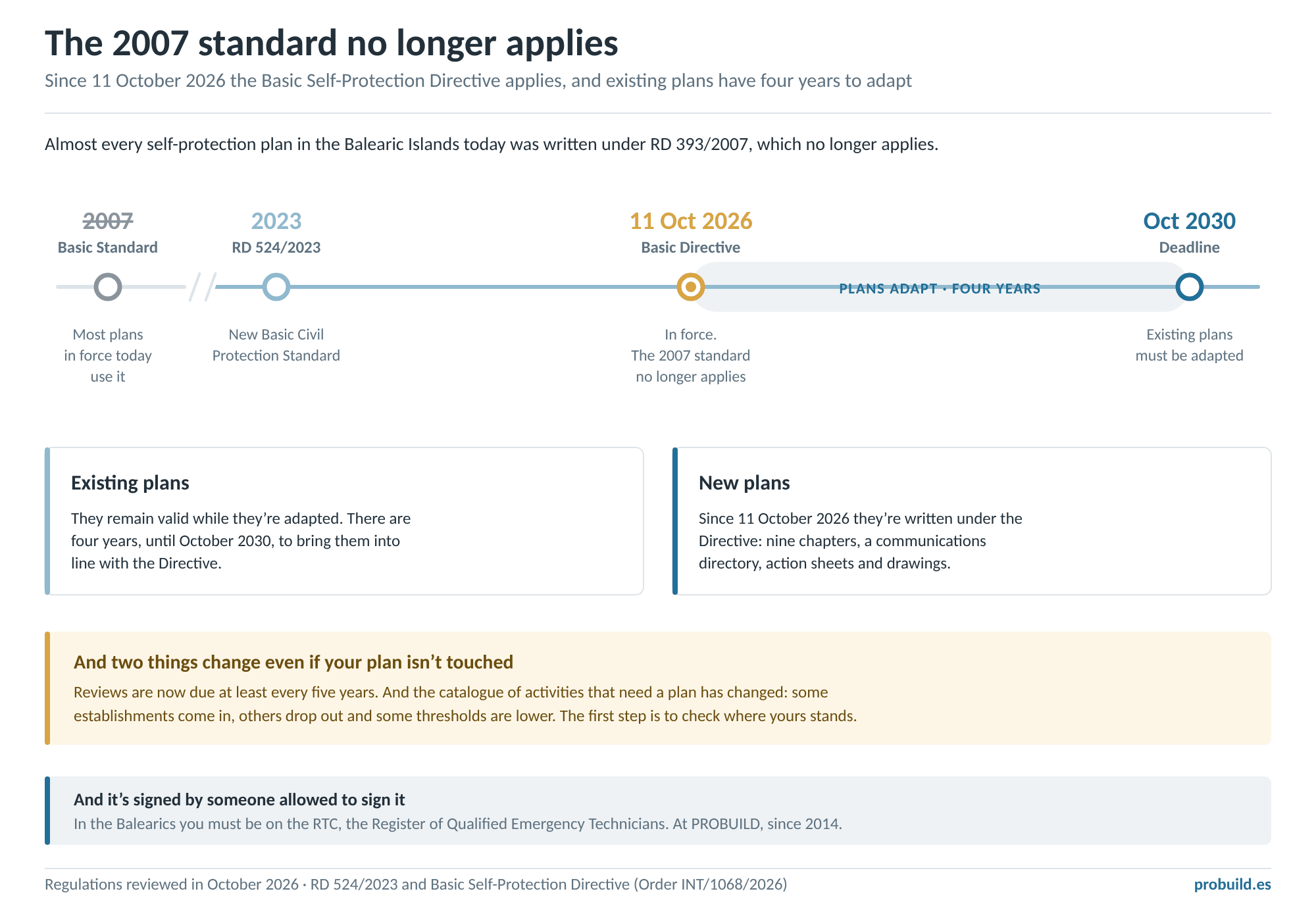
Since 11 October 2026, self-protection plans have been governed by a new standard: the Basic Directive on Self-Protection Planning. The 2007 Basic Standard, which almost every plan in the Balearic Islands was written under, no longer applies. Existing plans have four years, until October 2030, to adapt. And the list of who must have one has changed: some activities come in, others drop out and some thresholds go down.
Where it comes from
Royal Decree 524/2023, the Basic Civil Protection Standard, repealed the 2007 self-protection standard (Royal Decree 393/2007) and left the detail to a later basic directive. Until that arrived, the 2007 standard remained the reference. It has now arrived: the Council of Ministers approved it on 6 October, Order INT/1068/2026 published it in the Official State Gazette (BOE) on 10 October and it took effect the following day.
Who must have a plan now
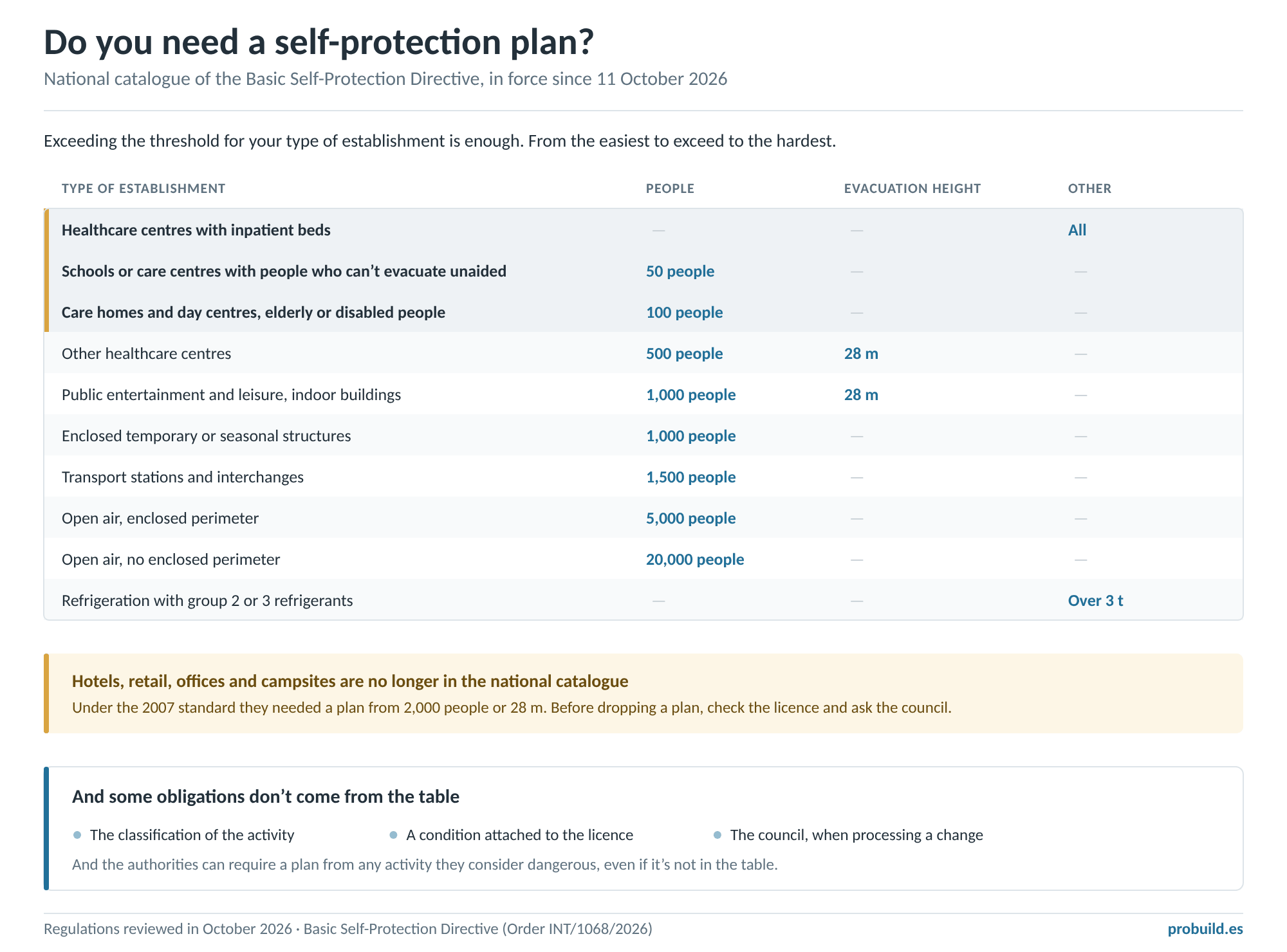
Annex I of the Directive is the new catalogue. It separates activities with their own sector regulations —industry with hazardous substances, chemical storage, ports, airports, public entertainment— from those without, such as healthcare, education and residential centres. For what comes up most in Mallorca:
| Activity | Under the 2007 standard | Under the 2026 Directive |
|---|---|---|
| Hospitals | 200 beds | All with inpatient beds |
| Care homes for older or disabled people | 100 people | 100 authorised places, not counting staff; now day centres too |
| Schools | 2,000 people or 28 m | 50 people who can’t evacuate unaided; the rest, according to their risk |
| Indoor entertainment and recreational activities | 2,000 people or 28 m | 1,000 people or 28 m |
| Temporary structures | 2,500 people | 1,000 people, if enclosed or seasonal |
| Hotels and public residential use in general | 2,000 people or 28 m | Out of the catalogue |
| Retail and offices | 2,000 people or 28 m | Out of the catalogue |
| Campsites | 2,000 people | Out of the catalogue |
| Refrigeration installations | — | Over 3 t of safety group 2 or 3 refrigerant |
The left-hand column is Annex I of Royal Decree 393/2007, the one that has been applied until now.
Hotels are out of the catalogue. That doesn’t mean what it seems
This is the change with the most impact in the Balearic Islands, and the easiest to misread. The national catalogue no longer includes hotel use, but the Directive itself leaves the authorities three ways to require a plan from anyone not on the list: impose it on any activity they consider hazardous in itself or because of its surroundings, require a joint plan from activities sharing a building, and demand corrections or updates when circumstances change. On top of that comes whatever each establishment’s activity licence says, and whatever the regional government decides, which it has not done yet: the CAIB register of self-protection plans still cites Royal Decree 393/2007 on its website.
The practical conclusion: no hotel should cancel its plan because it has read that hotels are out of the catalogue. What it should do is check, in writing, what applies in its own case.
What changes in the plan
- Structure. Annex II sets the minimum content in nine chapters —from identifying the holder and the site to the programme for keeping the plan effective— and three annexes: communications directory, action sheets for each emergency, and drawings.
- Review. The plan has no expiry date, but it is reviewed at least every five years, unless a sector regulation sets a shorter period. Under the 2007 standard it was three.
- Drills. As often as the plan itself sets and, in any case, at least once a year, with the results evaluated.
- Adaptation. Existing plans must be brought into line with the Directive within four years at most.
The change that affects building services
The catalogue now includes refrigeration installations using safety group 2 and 3 refrigerants with more than 3 tonnes in total, governed by Spain’s safety regulations for refrigeration installations (Royal Decree 552/2019). The plan has to state which refrigerants are used, their charge limits and their safety measures.
It affects industrial and logistics refrigeration plants, but it’s worth checking in any project moving to flammable refrigerants under pressure from the F-gas rules: an installation that stays below 3 t in the design can exceed it in an extension.
What to do if you already have a plan
- Check whether you still need one, and on what basis: the catalogue, the licence, the town hall or a sector regulation.
- Look at the date of the last review. If one is due before 2030, make the review and the adaptation one job, not two.
- If your activity has changed —a refurbishment, higher occupancy, a new activity—, the plan no longer reflects reality and needs reviewing now, under the Directive.
What we do. We write, implement and register self-protection plans. The engineer who signs them has been on the register of competent technicians required by Balearic regulations since 2014, and we don’t sell extinguishers or maintenance contracts. More detail on our self-protection plans page.
Regulations reviewed in October 2026: Royal Decree 524/2023 of 20 June, Basic Civil Protection Standard; Basic Directive on Civil Protection Planning for self-protection, approved by Council of Ministers Agreement of 6 October 2026 and published by Order INT/1068/2026 (BOE of 10 October), Annexes I and II; Royal Decree 393/2007, Annex I, for the comparison; and Balearic Decree 8/2004.